
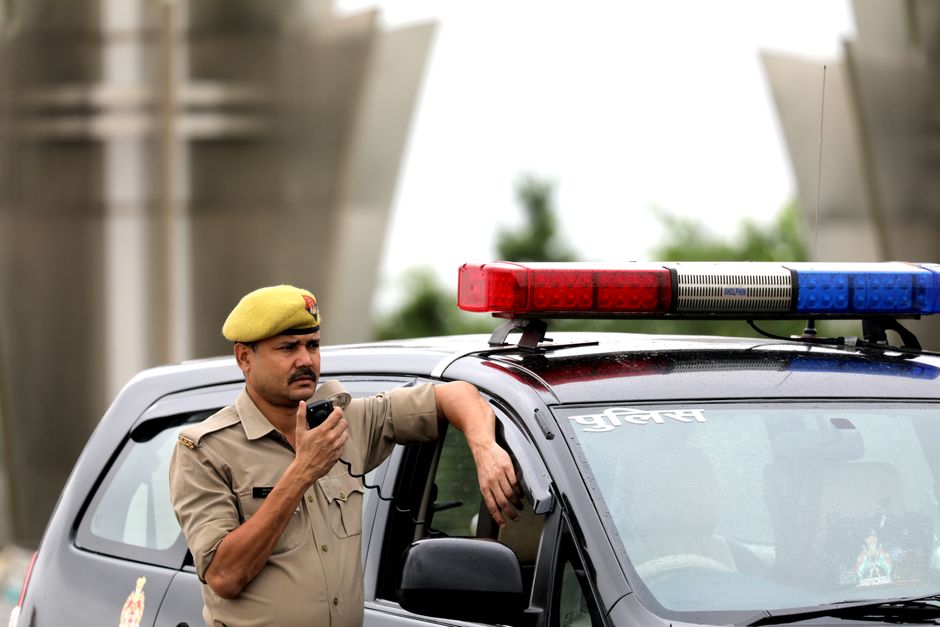
Authorities in Agra, Uttar Pradesh, have successfully apprehended three individuals, including the victim's wife, in connection with the brutal murder of a 39-year-old man. The deceased, identified as Lokendra Singh, was reportedly strangled and his body subsequently set ablaze in an attempt to conceal the crime. A distinctive tattoo on his hand proved to be a crucial piece of evidence, enabling investigators to identify the victim and ultimately crack the case.
Key points
- The victim, Lokendra Singh, 39, was found dead with his body partially burnt in an isolated area near Saiyyan bridge in Agra.
- Police managed to identify the deceased primarily through a unique tattoo visible on his hand, despite attempts to destroy evidence.
- Three individuals have been arrested: Lokendra Singh's wife, her alleged lover Mahesh Prajapati (a 35-year-old local fruit seller), and another accomplice named Dharmveer.
- The primary motive for the crime appears to be Lokendra's recent discovery of his wife's alleged illicit affair with Mahesh Prajapati.
- Investigators claim the accused conspired to eliminate Lokendra after he became aware of the relationship, leading to the murder on April 1.
- The accused have been charged under sections of the Bharatiya Nyaya Sanhita (BNS) pertaining to murder and destruction of evidence.
What we know so far
The investigation into Lokendra Singh's disappearance began on April 2 when his brother, Shivcharan Singh, filed a missing person complaint with local police in Agra. On the very same day, a half-burnt body was discovered, which was later positively identified as Lokendra Singh, thanks to a specific tattoo on his hand that survived the fire. This identification marked a significant breakthrough in the case, allowing the police to move forward with their inquiries into what was clearly a premeditated act of violence.
According to Agra Deputy Commissioner of Police (West) Aditya, subsequent investigation revealed a complex web of deceit and conspiracy. It was uncovered that Lokendra Singh's wife was allegedly involved in an illicit relationship with Mahesh Prajapati, a 35-year-old fruit seller operating in the local area. Police reports indicate that Lokendra had recently become aware of this affair, a discovery that allegedly prompted the accused to hatch a plot to eliminate him.
The alleged murder itself took place on April 1. On that fateful day, Mahesh Prajapati and his co-accused, Dharmveer, reportedly lured Lokendra to an isolated spot situated near the Saiyyan bridge. Prior to the commission of the crime, it is understood that the trio consumed alcohol together. Following this, Lokendra was allegedly strangled, and his body was then set on fire in a desperate attempt to destroy any identifying evidence and obscure the nature of the crime. Police have since arrested all three individuals involved in the alleged conspiracy and murder. Authorities have also confirmed the recovery of two mobile phones and the clothing worn by the accused during the incident, which are expected to serve as crucial evidence in the ongoing legal proceedings.
Context and background
This case highlights the critical role of forensic science, even in its simpler forms, in modern criminal investigations. The identification of Lokendra Singh's body through a tattoo underscores how personal markings, often overlooked, can become invaluable clues when other methods of identification are compromised. In instances where bodies are severely disfigured or burnt, traditional identification techniques like facial recognition or dental records become challenging. In such scenarios, unique physical attributes such as tattoos, scars, or even specific medical implants can provide the necessary leads for investigators to establish identity, which is the first crucial step in solving a murder case.
Furthermore, the alleged motive of the crime—a love triangle leading to murder—is unfortunately not uncommon. Such incidents, often referred to as "crimes of passion," arise from intense emotional conflicts, jealousy, or a desire to remove obstacles to a relationship. These cases often involve individuals known to each other, making the emotional stakes and the potential for violence exceptionally high. The planning involved, including luring the victim and attempting to destroy evidence, suggests a premeditated act rather than an impulsive one, which typically carries more severe legal implications.
The arrests have been made under specific sections of the Bharatiya Nyaya Sanhita (BNS), which is India's recently enacted criminal code, replacing the archaic Indian Penal Code (IPC). Section 103(1) of the BNS deals with murder, outlining the definition and penalties for causing death with intent or knowledge. Section 238 of the BNS addresses the destruction of evidence, which is a serious offense aimed at obstructing justice and hindering investigations. The prompt action by the Agra police, facilitated by the brother's complaint and the successful identification, demonstrates the commitment of law enforcement to bringing perpetrators of violent crimes to justice and upholding the rule of law.
What happens next
With the arrests made, the legal process will now move into its subsequent phases. The accused individuals—Lokendra's wife, Mahesh Prajapati, and Dharmveer—will be presented before a magistrate. They will likely be remanded to judicial or police custody to allow investigators further time to gather evidence, conduct interrogations, and finalize their chargesheet. The recovered mobile phones and clothing will undergo forensic analysis to extract any digital data or physical traces that could corroborate the police's narrative or uncover additional details about the crime.
Once the investigation is deemed complete, the police will file a detailed chargesheet in court, outlining all the evidence collected against the accused. This will include witness statements, forensic reports, and any confessional statements made during custody. The court will then frame charges, and the trial will commence. During the trial, both the prosecution and the defense will present their arguments and evidence. The prosecution will aim to prove the guilt of the accused beyond a reasonable doubt, while the defense will seek to challenge the evidence and establish their clients' innocence. This process can often be lengthy, involving multiple hearings, witness testimonies, and expert opinions, before a final verdict is reached by the court.
FAQ
- Who was the victim in this case? The victim has been identified as 39-year-old Lokendra Singh.
- How was Lokendra Singh's body identified despite attempts to conceal it? His body was identified through a distinctive tattoo on his hand, which survived the burning.
- Who has been arrested in connection with the murder? Police have arrested Lokendra Singh's wife, her alleged lover Mahesh Prajapati, and an accomplice named Dharmveer.
- What was the alleged motive behind Lokendra Singh's murder? The motive is believed to be Lokendra's discovery of his wife's alleged illicit affair with Mahesh Prajapati.
- What charges do the accused face? The accused face charges under sections of the Bharatiya Nyaya Sanhita (BNS) related to murder and the destruction of evidence.


